Tag: Oscilloscope

  • Spring… a beautiful time of year! I particularly enjoy the warm rains, with the soothing effects of raindrops pit-pattering into puddles outside my window.

    But no longer do I need to look outside! Inspired by a recent post on Hackaday, a suggestion from [A-Nonamus] in the neonixie-l group, and by Spring itself, I can now enjoy Timedrops on my Oscilloclocks:

    See this in HD, and find more exciting videos on my YouTube channel
    Music credits: Space Bazooka by Kirkoid (c) 2013 Licensed under a Creative Commons Attribution (3.0) license. http://dig.ccmixter.org/files/Kirkoid/43005

    Assembly?!

    A sprite engine
    A sprite engine

    The current Oscilloclock firmware is written entirely in PIC 18F Assembly. The Timedrops feature leverages a Sprite Engine module, first developed for Halloween Seasonal Treats and later utilized in the Santa’s sleigh feature.

    To display Timedrops, the sprite engine is initialized with 10 sprites – 4 digits for hours and minutes, a colon, and 5 ellipses as ‘ripples’. The 5 characters are set at the top of the screen with a randomized negative velocity. When a character reaches the bottom boundary, the sprite engine’s default explode sequence is started, and the associated ripple sprite is made visible and set to expand. When the explosion sequence for a character sprite is complete, the sprite is reset at the top of the screen.

    Looking for the source code? Sorry – refactoring is still under way, and the latest revision with the Timedrops feature will be uploaded in the near future.
  • More 2015 craziness – the CopperClock!

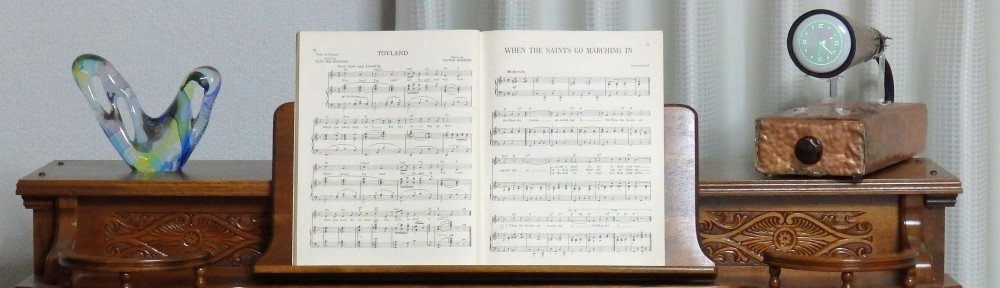
    Happy New Year! Looking back, 2015 was a superb year, full of fun and fancy. And just in case you thought last year’s creative juices were exhausted by the fabulous Oscilloblock, rest assured that there was an even crazier creation – the 2015 luxury edition CopperClock!

    CopperClock on shelf 01

    The unusual facade for this unit was built to order by a Canadian craftsman specializing in hand-hammered and silver-soldered copper weather vanes. If you enjoy metal art, you will certainly approve of this!

    Oscilloclock CopperClock 01

    But… you may have read my previous articles and know that three-inch Oscilloclock models are typically powered by 2.1kV high voltage power supplies. Isn’t there any danger in using a metal case?

    Never fear! The internals are fully encapsulated in a beautiful cast acrylic case, providing full insulation and utmost safety.

    Oscilloclock CopperClock - internals 01

    Breaking from tradition, I’ll refrain from describing other features of this unit (such as the selection of a round-faced CRT to give it character), and instead just post a few more photos of the clock ‘in situ’. Enjoy!


    The 2015 CopperClock atop a beautiful Philips Radioplayer. What a match!
    ... or perhaps atop a vintage Estey pump organ?
    … or perhaps atop a vintage Estey pump organ?
    ... perhaps it looks best on a 1920's Edison Diamond Disc Phonograph!
    … perhaps it looks best on a 1920’s Edison Diamond Disc Phonograph!

    Like what you see?

    This exquisite specimen is currently available to someone with a metallurgical and chronometric disadvantage. Visit the Availability page for more information, and of course see the Gallery for other unique creations!

  • Toshiba Transformed

    I believe in reincarnation. Every vintage device sporting a CRT deserves to live again, to be loved again, to lift someone’s spirits again. And in 2014, this beautiful Toshiba ST-1248D received its chance, born again as a suave Oscilloclock!

    Toshiba ST-1248D Oscilloclock
    See this in HD, and find more exciting videos on my YouTube channel

    Manufactured sometime in the mid to late 1950’s, the ST-1248D was extremely well-designed and assembled, compared to other compact models available on the domestic Japanese market at that time. The engineers considered both function and form – latched panels on the side and back, delicately laced wiring, and a relatively spacious interior conducive to heat removal and circuit reliability. But the delightful brass bezel is what really makes this one of the most beautiful Oscilloclock conversions ever.

    Toshiba ST-1248D - Brass bezel
    (more…)
  • Oscilloclock in a Book!

    Now here’s a familiar picture!

    Oscilloclock Heathkit OR-1 in Chuck Penson's Heathkit Test Equipment Products book 1

    It seems that the Heathkit OR-1 is a very rare oscilloscope nowadays, and Chuck Penson reached out to me for a photo to put into his latest book, Heathkit Test Equipment Products. This is a very well-written, well-researched treasure trove of data about the most iconic kit manufacturer of its time. Highly recommended!

    Chuck Penson's latest book - superbly authoritative
    Chuck Penson’s latest book – superbly authoritative

    And of course here is the Oscilloclock Heathkit OR-1 again, in all its glory:

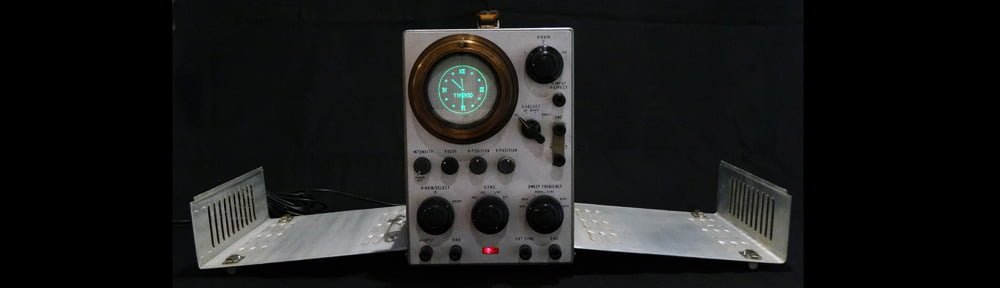
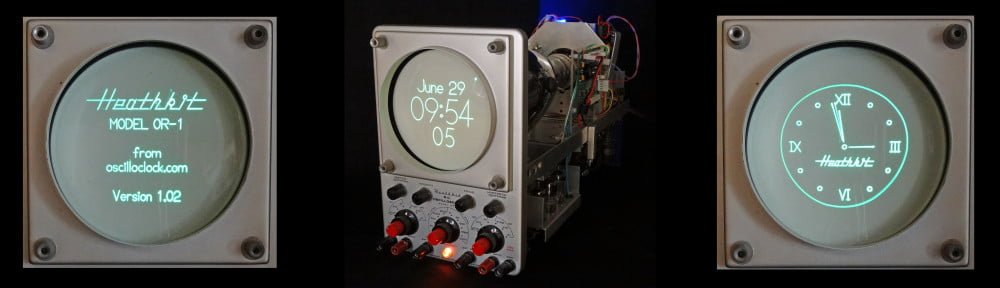
    Heathkit OR-1 Oscilloclock
  • VGA display… On a 3″ scope tube!

    Yes, you’ve all thrown away your lunky old CRT monitors, in favour of sleek ultra-thin LCD displays. And, you thought you’d never see another one again…

    But this CRT display has a twist! It’s round. It’s small at just 3 inches diameter. And it’s awfully cute.

    Oscilloclock 3-inch CRT VGA Display Assembly - overview

    Last year, I was approached by a dedicated flight simulation enthusiast, who needed a radar indicator to use in a fighter cockpit replica. The indicator should employ a CRT, for the most realistic look. Could Oscilloclock design and construct such a display?

    It didn’t take much convincing! Diverging only temporarily from building clocks, I took up the challenge to create my first raster-scan CRT display unit. In the ensuing months, difficulties sprang forth from every direction in the project, but ultimately I was able to avoid a diraster (sic) and deliver a functional assembly:

    See more related videos on my YouTube channel

    The Setup

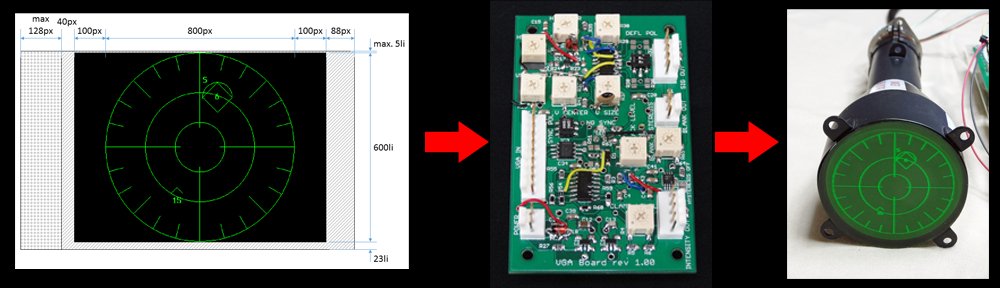
    The key component of this setup is a new prototype VGA Board that converts a VGA signal into analogue X and Y outputs. Both analogue intensity and binary blanking outputs are provided.

    Oscilloclock VGA Board prototype
    Oscilloclock VGA Board prototype

    The X and Y outputs drive an Oscilloclock Deflection Board, while the binary blanking output drives the blanking amplifier in a CRT Board. Blanking isolation, heater, and HV supplies are provided by a Power Board.

    Oscilloclock Deflection Board - modified for ultra-linear HV output
    Deflection Board – modified for ultra-linear HV output
    CRT Board - heavily modified for improved frequency response
    CRT Board – modified for improved frequency response
    Power Board - with improved optocoupler
    Power Board – with improved optocoupler

    It all looks so easy! But noooo. Astute readers will recall from other posts that every Oscilloclock project involves sleepless slumbers, horrific hair-pulling, and forgotten family members. Let’s see what caused me grief this time…

    (more…)