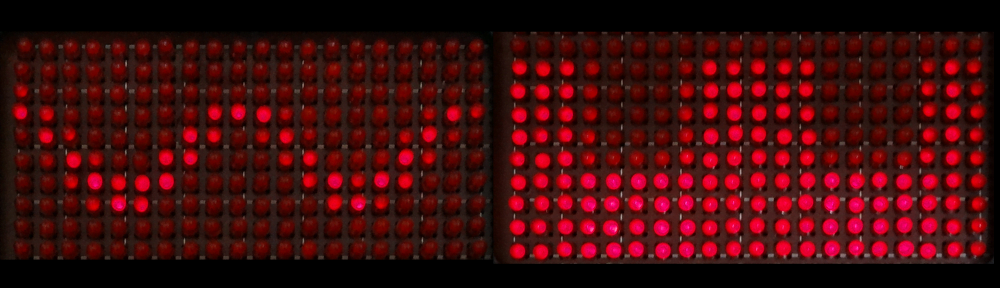
Recently, I’ve seen quite a few search hits and even an enquiry regarding the 400-LED dual-trace oscilloscope that I briefly mentioned on my History page. With renewed enthusiasm therefore, let’s take a trip down history lane and see what I was doing back in 1990!
A compact dual-trace 1MHz DC scope – what more could a high school kid want?(more…)
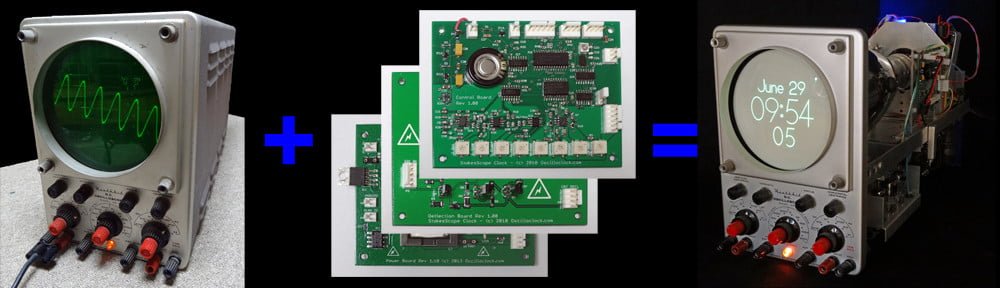
Last month’s post about the Heathkit Oscilloclock generated tremendous interest, and I’ve heard from several folks keen to try their hand at preserving their own beloved instruments.
… so let’s take a brief look at what was involved in the Heathkit OR-1 conversion!
Approaches to conversion…
There are many approaches to retrofitting a scope into an Oscilloclock, but it really boils down to how much of the original circuit you want to re-use, vs. what you will bypass with Oscilloclock boards.
In Transformer Corner Part 3, I looked at how to choose materials for a custom HV transformer. One way was to pull stuff from the junk-box – I did this in my early Prototype. The much, much better way was to use an off-the-shelf core with documented specs.
Let’s look at winding up the transformer. It’s amazingly easy to get a workable result!
In Transformer Corner Part 2, I looked at the power supply used in my early Prototype, and showed how to determine the key requirements for the HV transformer.
Now, let’s see how I could choose the materials and design the transformer – without any pesky mathematical formulae!
The end goal – a hand-wound HV transfomer!
Picking a core
The first challenge was to find a suitable core from my junk box. First off, recall from Part 1 that this couldn’t be iron (too ‘slow’ for 151 kHz), and it couldn’t be air (too ‘weak’ for 25mA). I suppose I could have tried plastic, milk, or even beer – but I knew better. I knew about a substance called Ferrite.
In Transformer Corner part 1, I introduced one of the key parts of the Oscilloclock – the HV transformer, and tried to illustrate some of the concepts and history behind it.
Next, let’s explore the Prototype’s power supply configuration. This will tell us a lot more about the transformer I had to wind!
Power supply design
My greedy little Oscilloclock wanted lots of different voltages…