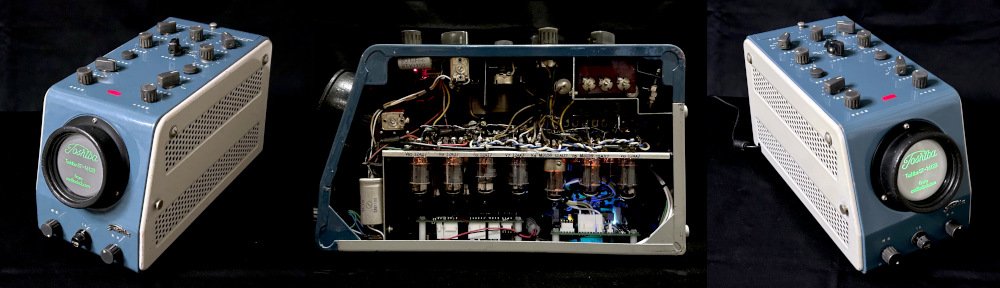
Here at the Oscilloclock Lab, we see a lot of vintage Japanese oscilloscopes made in the 50’s to 70’s. Most were purely utilitarian and austere, with little aesthetic appeal.
But this Toshiba ST-1612B is different. It’s cute, compact, and culture-rich. Just when we thought Toshiba had exhausted its artistic reserves with their stunning ST-1248D, they managed to come up with THIS. Wow…

Oscilloclock’ed!
We discovered our protagonist some years back – dirty, dusty, and destined for the trash heap. For aeons, it sat in stock, patiently waiting its turn.

During our COVID-era hiatus, this unit’s pitiful wail fell on deaf ears. But with a strong recent recovery in parts availability, shipping routes, and other stabilizing factors, the Oscilloclock Lab has begun to thaw. Spring has arrived!
And what better way to mark the occasion than to grant our Toshiba its wish?
Done.

Exquisite exterior
The case and knobs were in reasonably good condition and polished up very nicely…


Sadly, the leather carrying strap had seen better days. Yes, you read that correctly! This was designated as a portable oscilloscope, although it weighed in at more than 10kg, and had no battery supply!

We love this adorable hatch compartment and secret patch panel. So utilitarian! Whole tribes of radio servicemen must have stashed their valuables here for safe keeping, before going away on holiday. Sadly, there was no jewellery or secret documents to be found in our unit…


Take a look at this CRT hood. The phosphor screens in cathode-ray tubes are sensitive to external light, so many ‘scopes employed hoods or shades to keep ambient light out. This improves screen contrast for the lucky operator. Kudos to you if you can recognise the material used our Toshiba’s hood:

Yes, it’s rubber. Solid rubber, with no metal tube inside. And while it’s a little banged up on the surface, it’s not disintegrating or brittle! It’s firm, yet still sufficiently flexible to support the CRT. And a little plastic polish did wonders. Good for another 60 years!
Incredible internals
Unlike many other scopes of the era, opening the case is easy. Just turn the latches with a coin, a single revolution. Voila!

As with its Toshiba brother and several other units crafted to date, we carefully installed amber LED lighting to simulate the original warm, gentle glow of electron tubes. This generates a beautiful, peaceful ambience.


XY Input inspires!
Avid readers may recall the XY Input feature first introduced in the Metropolis Clock, and included in several models since.
This ST-1612B unit features a neat set of banana jacks in the rear hatch compartment, where the oscilloscope probes used to plug in. We repurposed them as X and Y channel signal input connectors.


Driven by function generators, preamps, or even a mobile phone, we can explore an entirely different level of visual imagery!
A just-fit retrofit
The ST-1612B was an engineering marvel. They packed an amazing amount of circuitry into a very limited space.
But we needed to find space for two 100 x 80mm Oscilloclock boards. With legroom to isolate high voltage and provide circulation. And where controls can be reached. Not easy!
Well, removing just a few bits and pieces* revealed two nice big cavities. And the best part? There were already access panels, complete with ventilation holes! What foresight those Toshiba designers had!


Control Freak
You can’t beat vintage test equipment if you like controls: toggle switches, slide switches, rotary switches, potentiometers, trimpots – these guys have it all!
But at Oscilloclock.com we target simplicity. There is only one control you need to turn the clock on and off, change faces, change settings, and generally play with your precious. Here, the focus control (焦点) gives you this authority. Who would ever guess?

And for that most discerning owner, keen to install her beloved Toshiba ST-1612B in a moody environment such as a bar counter, living room, or bedroom: the intensity control (輝度) dictates the velocity of the electrons, as they smash haplessly into the phosphor. Okay, okay – it’s just a brightness control!
Finally: we’ve wired up the frequency range switch (周波数範囲) to switch something on and off. We haven’t decided what. Let the Toshiba’s future owner decide its fate!

Circle Graphics – with a caveat
Oscilloclocks employ Lissajous figures to generate smooth, curvy artwork and characters on the screen. No pixelated, chunky graphics! But fastidious followers may spot that on the Toshiba ST-1612B’s screen, circles are not as perfect as advertised in our Circle Graphics post. And there are some jagged edges on the segments.

This is because we’ve installed some prototype boards. These are early revisions of the yet-to-be-announced New Design, and the circle generator and deflection amplifier circuits aren’t quite right. But they’re too good to waste.

But we think it’s just fine! Tube amplifier enthusiasts understand: vinyl records and tube amplifiers actually sound better than digital devices, for some music. And our Toshiba here is 50 to 60 years old. A few kinky curves only add to its grace.
The Toshiba ST-1612B Oscilloclock is in stock and ready to perform. Want to customize the screens? Decide on the secret switch’s secret? Work up some crazy XY effects? Check our Availability page!