Tag: 菊水電子

  • Made in Japan. Forever.

    “Made in Japan” — a label so rarely seen on electronic equipment today.

    But there was a time.

    That time was 70 years ago.

    That time is Now.

    Presenting the Kikusui MC-120 Oscilloclock!

    In 2025, ~Brian~ reached out to commission an Oscilloclock build. He had just 3 requirements:

    1. He wanted a custom conversion of an original vintage device.
    2. The device should have a large screen — at least 4″ diameter.
    3. The finished clock should include the Metropolis theme feature.

    We prepared an exclusive catalogue with select devices in our stock that would meet the large-screen requirement.

    ~Brian~ immediately spotted the model he wanted!

    It seems the finish of this unit reminded him of military devices his grandfather had once owned. Well, your senior Oscilloclock engineer certainly knows the influence a grandfather can have. A great choice, for all the right reasons!

    Fast forward to May 2026 — and the labour of love was complete!

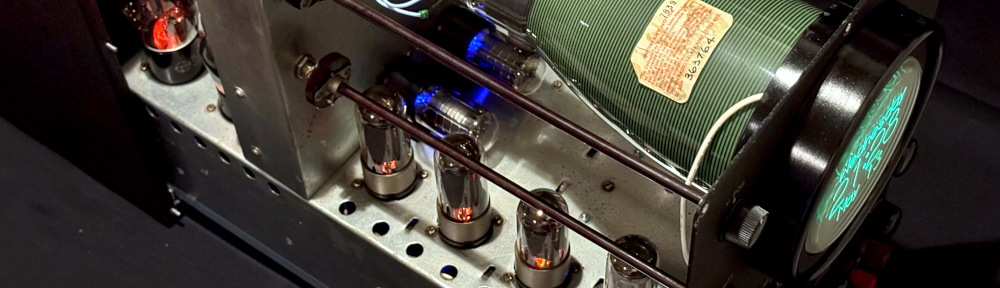
    Oh, my! Just look at those internals!

    We discovered at an early stage that the MC-120’s chassis slides out from the case relatively easily. Could we reduce friction enough that ~Brian~ could easily pull the unit open any time he wanted to gaze at the internals?

    ABSOLUTELY we could, and we did!

    But we took it one step further, by installing LED lighting into the tubes — simulating the look and feel of the original ‘scope in actual operation!

    Metropolis marks its 100th anniversary

    True to ~Brian’s~ every desire, his clock features the Metropolis themed screens, in addition to the the standard screens always available by default.

    This is perfect timing(!), as 2026 marks the 100th anniversary of the marvelous Metropolis movie by Fritz Lang!

    Screens are kept simple, but they bring a lot of pleasure!

    Latched on to Panels

    Avid readers may remember that we LOVE oscilloscopes that have panels. Especially those with latches. Check out our posts here, here, and here! We can’t resist playing with them, and we are absolutely not alone in this fetish.

    Well, this MC-120 also has a lovely latch panel in the rear. We’re not using it for anything. But look carefully! You can just see one of the LED-lit tubes inside…

    Wave for the camera!

    How do Oscilloclocks keep accurate time? We’ve written a full treatise before about the various options available. For the MC-120, we chose to install a custom Oscilloclock Wave board enabling NTP time synchronization over WiFi.

    This board has been designed specifically to replace the no-longer-necessary fuse box in the rear of the scope:

    Wait – reduce Weight!

    The Kikusui MC-120 in its original form weighed at least 20kg (45 lbs). ~Brian~ accepted our pragmatic suggestion to strip out the original power transformer and choke coil, bringing the weight of the entire unit down significantly.

    This weight loss helped greatly to reduce force required to pull out the chassis. But equally importantly, it halved the shipping costs!

    During the build, we also stripped out a number of other components. But don’t worry, most will not go to waste. Tube amp enthusiasts love transformers!!

    Hang on, where’s all the circuitry??

    ~Brian~ wished to retain the orginal looks above the chassis, so we mounted all Oscilloclock circuitry underneath!


    Like what you see?

    Actually, we hope you don’t like this specific Kikusui MC-120 too much, because it’s unlikely that we will ever come across another one! But never fear; we have other devices aplenty. We must have something special for you. And we can do some special things with it. Just let us know your ideas.
  • Kikusui Time

    Time – the universal constant. Time passes the same for all peoples; rich or poor, busy or idle, inspired or dispirited. And time has certainly passed for Oscilloclock.com since the 2015 Tokyo Maker Faire – the event that just keeps giving!

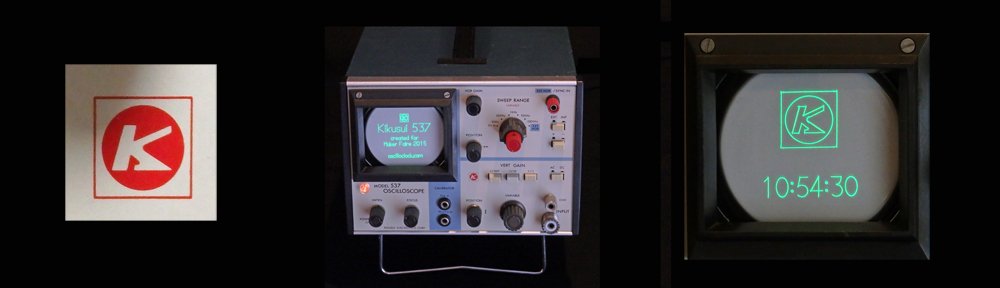
    At last, we present the final model from that Faire – the Kikusui 537 Oscilloclock!

    See this in HD, and find more exciting videos on my YouTube channel

    The Kikusui 537 was hand-picked for conversion by the lab’s youngest technician (9 at the time). He chose it for its small size and portability, but also for its cute colour scheme! A dainty red sweep adjustment knob highlights a bright white and black control panel, with a blue case providing overall contrast and visual soothing.

    Kikusui 537 Oscilloclock

    The 537 Oscilloclock’s small size makes it the perfect clock for an office desk, bedside table, or mantle. And since this is a ‘maximum re-use’ conversion, the existing circuit is active and all the front panel controls are fully functional. Fiddle with the image’s size and position to your heart’s content! Switch from XY mode to normal sweep mode, to view raw Oscilloclock signals in real time, as the seconds tick by!

    History

    Kikusui Logo
    The Kikusui Electronics Corp. logo

    The 537 was manufactured by Kikusui Electronics Corp., a major producer of test equipment in Japan since 1951. It was produced in large numbers from 1975 and was extremely popular for its small form factor, solid-state design, 5 MHz bandwidth, and ‘low’ price of 45,000 yen (perhaps USD 1,000 in today’s terms). See the catalogue page (Japanese only) and the operating manual (Japanese and English).

    Construction highlights

    In a previous post, I mentioned there are several general approaches to converting an oscilloscope. Since the Kikusui 537 is fully solid-state (it uses transistors instead of valves/tubes, except for the CRT) and it is only 40 years old, I decided on the maximum re-use, minimal invasion approach. (I really should trademark that term!)

    This approach involves tying the Oscilloclock Control Board‘s outputs directly into the existing X and Y amplifier circuits. This was easy to do in the 537!

    Kikusui 537 Oscilloclock - inside top
    Oscilloclock Control Board mounted in the 537

    However, as discussed in the Circle Graphics post, we also need to be able to blank the beam at extremely precise intervals. Sadly, the 537 (like nearly all oscilloscopes of this vintage) does NOT have a convenient DC pulse-tolerant Z-axis input. I therefore installed an Oscilloclock Power Board, partially populated to serve as an isolated blanking amplifier, in series with the grid.

    Partially populated Oscilloclock Power Board
    Partially populated Oscilloclock Power Board

    Finally, an Oscilloclock Supply Board was needed to power the other boards.

    An Oscilloclock Supply Board is also nestled in there!
    An Oscilloclock Supply Board is also nestled in there!

    Mounting the Control

    What better place to fit the rotary encoder, than on the beautiful red sweep frequency adjustment knob that my junior technician liked so much! Here’s the general story:

    Kikusui 537 Oscilloclock - control (original)
    Sweep adjust control in its original state
    After removing the potentiometer
    After removing the potentiometer
    The encoder, after hacking with a hacksaw!
    The encoder, after hacking with a hacksaw!
    Kikusui 537 Oscilloclock - control mounted
    Voila – sweep knob now drives the rotary encoder!

    Like what you see?

    One of the two Kikusui 537 Oscilloclocks crafted for the Maker Faire is still available for the special person with a soft spot for a krazy kikusui klock. Visit the Availability page for more information, and of course see the Gallery for other unique creations!