• Mass Production – in Threes

    Mass Production – in Threes

    For Christmas, @oscillokid gave your humble senior Oscilloclock engineer a book: Why do Buses Come in Threes? It’s a playful tome, with surprising facts about how mathematics plays a part in nature and society.

    From three-leaf rules in plants, to the musical triad, to triple bird call repetitions, to The Three Body Problem — this magic number is everywhere.

    And it’s no coincidence that Oscilloclocks also Come in Threes!

    Do Oscilloclocks really come in Threes?

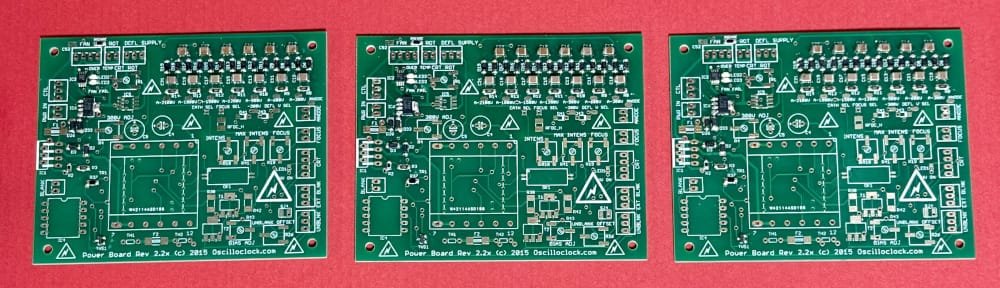
    Yes! But to be more precise, it’s the Oscilloclock printed circuit boards that come three at a time. Here you can see three boards being assembled:

    The Oscilloclock lab — where life happens in triplicate!
    These three Power Boards still have a longgggg way to go…

    Why in Threes?

    Well, every component of your Oscilloclock is manually picked from a bin, manually placed on the board, and manually hand-soldered.

    In a standard Oscilloclock model such as the Model 1 or the Exo, there are more than 300 individual parts!

    Picking, placing, and soldering just one board is onerous. Two boards? Tedious! And in such finite physical space, four boards is futile. Three wins!

    Wait – do you even procure in Threes?

    Each bin contains multiples of 3 + a bit extra

    Yes. We order parts from reliable distributors in very small quantities. The magic formula is a small multiple of 3, plus an extra one or two to fit minimum quantity restrictions and to cover parts attrition. The duly received parts are then manually unpacked and manually placed into the bins.

    By the way, parts attrition is the phenomenon where parts are wasted: misplaced, incorrectly mounted, or broken during assembly. At the Oscilloclock lab, we are proud to have an average attrition rate of less than 2%!

    Why procure parts in such tiny quantities?

    Ordering in large quantities is cheaper.

    But — we want the latest and greatest for our Oscilloclock owners! Even for the exact same component type and the same manufacturer, fresh lots may perform better and/or last longer than older lots, thanks to advances in design or manufacturing processes.

    Additionally, Oscilloclock circuit designs are constantly evolving. We prefer to adapt to newer component types regularly (with a few exceptions).

    Having a huge backlog of old stock would encourage us to stagnate. No way!

    Why not “mass produce”?

      Simple. Our motto is ‘Hand Crafted Scope Clocks’! This means an artisan design and assembly process, right down to the soldering.

      This fits with the Made In Japan mantra and the country’s ものづくり (monozukuri) culture. In an era where board factories are exclusively located overseas, embracing hand assembly helps keeps things local.

      Lastly, factory procurement and assembly is more costly in Threes. And we don’t want to increase quantities, as we constantly evolve the designs.

      But isn’t hand assembly a lot of effort?

      Yes, it is. Procuring the parts and assembling the boards takes hours. But it’s worth it to our Oscilloclock engineers!

      • The sheer joy of hand-crafting something for someone else.
      • The control over aesthetics such as precise component placement.
      • A dopamine rush as anticipation grows to the climax of final testing!

      We DO use factory assembly sometimes…

      That said, we aren’t silly! We DO use factory assembly for bespoke work where miniaturization or performance demands outweigh the joys and aesthetics of hand assembly.

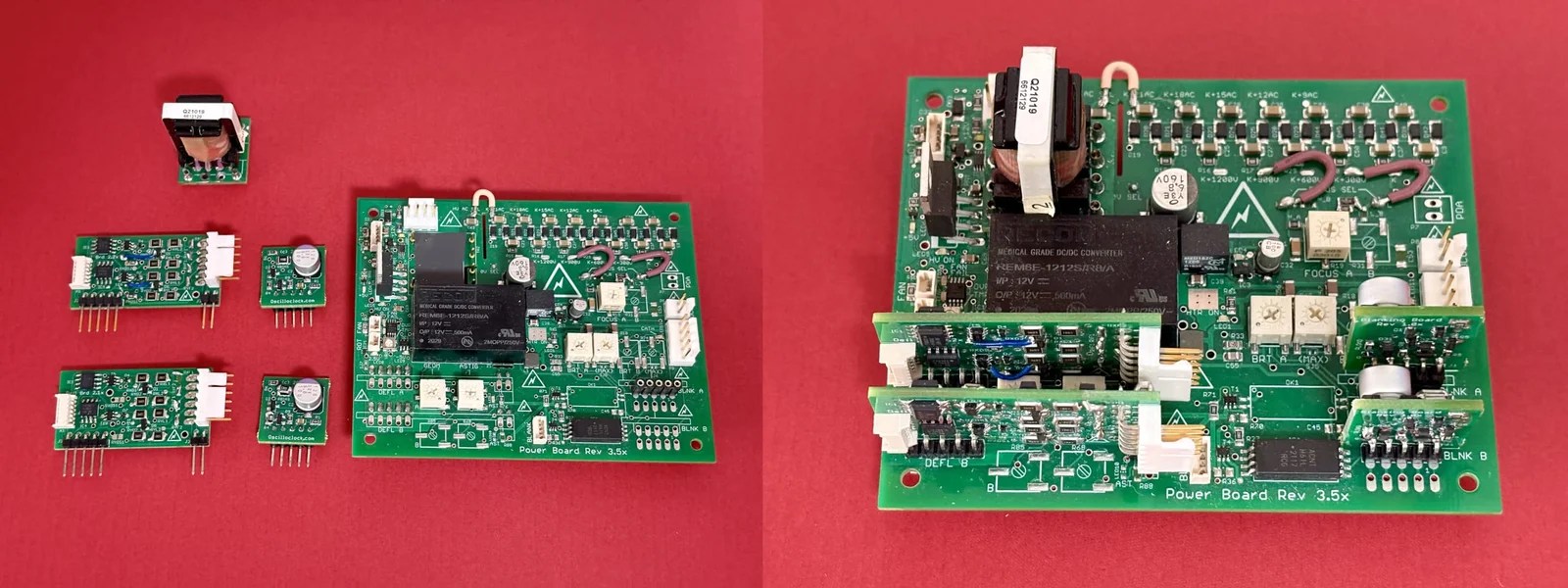
      For example, the heavily specialized Oscilloclock Core Duo System below is designed to drive dual-gun cathode-ray tubes in a very small form factor. At this level of miniaturization, factory assembly is a given.

      The Oscilloclock Core Duo System! 90% factory-assembled

      What else is “Hand-Crafted”?

      Acrylic. We use cast acrylic (not extruded). The raw material is manufactured in Japan, and then machined locally, by hand, and to order.

      You guessed it – we order custom acrylic parts In Threes!

      Fan mounts. We’ve shown this before, but we can’t help but show it again!

      Cables and Harnesses. Hand- everything! See our earlier write-up.

      The Printed circuit boards themselves? No! Sorry to disappoint you, poor reader, but the last time we etched PCBs was for the Prototype. With all the messy chemicals and finicky alignment required for double-sided boards, we draw the line here!


      They say, “Good luck comes in threes”. We think so. And our patrons must think so, for several of them have commissioned three (or more) devices!

      Do you want to explore possibilities? Reach out with an idea. Or three!

    1. Cores for a Good Cause

      Cores for a Good Cause

      [Mike], a cathode-ray aficionado and a major sponsor of Oscilloclock’s X-Y-Z Core design, reached out earlier in the year with devastating news:

      His home, workshop, and all its contents had been completely destroyed in the Palisades Fire (California, U.S.) in January.

      We at Oscilloclock are no strangers to earthquakes, typhoons, nuclear meltdowns, and even bear invasions. But we have never witnessed our home, lab, and all surroundings destroyed in a wildfire such as [Mike] experienced:

      Homes and neighborhoods devastated by the Palisades Fire. Jan. 14, 2025

      What was lost…

      [Mike] had been designing and building his own cathode-ray tube based clocks. His focus was on the controller – the microcontroller-based circuit that generates signals telling the CRT’s electron beam where to go, and when to turn on and off. He also designed and built the clock cases himself.

      He’d needed help for the high-voltage power supply, deflection amplifiers, and isolated blanking amplifier. These are a little complex (not to mention dangerous), so he’d decided to use the well-matured Oscilloclock X-Y-Z Core product to do all the heavy lifting – so he could just focus on the controller.

      And, we’d provided him with a bunch of lovely vintage CRTs.

      Putting all these together, Mike had made 4 complete clocks – and wow, they were beautiful!

      4 clocks ticking in unison. Blissfully unaware of the disaster awaiting…

      Of the four clocks thus constructed, two had gone to [Mike’s] friends.

      However, one of the clocks had come to [Mike] for repairs right at the time of the fire.

      And just like that – three works of art were lost forever.

      The road to recovery

      Since the fire, [Mike] has been living in smaller quarters, with no room (and, you can imagine, not much time either) for hobbies.

      But we both knew he’d be back into it! And when he reached out in April to discuss getting more XYZ Cores, in anticipation of a fresh year-end re-start, we were overjoyed. To what better cause could a couple Cores contribute?

      Two new X-Y-Z Cores, CRTs, cabling, accessories – everything [Mike] needed to get back to work!

      [Mike] recently reports that he’s managed to rent a workspace, and will be setting up again from December!

      We can’t wait to see what transpires.


      We wish the very best to [Mike] and all others affected by disasters, whether natural or inflicted, as they rebuild their lives. And may they never give up in their quest to increase the artistic entropy of our world!

    2. Slow motion

      Slow motion

      Nestled amongst the standard features that come with all Oscilloclocks is a special effect called “Slow motion”. We suspect very few owners have noticed this feature, and fewer yet have actually tried it! It hasn’t been very well advertised… Until now!

      This Exo really likes the slow life!

      No, this video is NOT just being played back slowly.

      It’s the graphics rendering itself that

      has

      been

      slowed

      down…

      Welcome to the Slow motion feature!

      What is it doing?

      As described in Circle Graphics, every image and character shown on your Oscilloclock is constructed from segments. Each segment is actually an ellipse, arc or a line.

      Normally, an image (or text) is displayed on the screen by drawing its segments very quickly, all within the time of one frame. Each frame is completely redrawn 50 times per second. By repeating the drawing so rapidly, and adding in some persistence effects of the CRT phosphor, the human eye can’t see individual segments being drawn.

      But when “slow motion” is enabled, only one segment is displayed per frame. For an image or text with 50 segments (at 50 frames per second), it would take 1 second to draw the entire image. At this rate, the eye can easily distinguish each segment as it is rendered!

      Even the original Prototype from 2009 boasts this glorious feature!

      Enabling slow motion

      It’s in the menu!

      Menu → Effects → Slow mo delay

      A delay value other than 0 turns on the effect. This number indicates the number of frames that each segment will be displayed, before moving on to the next segment. Increasing the number therefore makes for a “slower” rendering of the image.

      In the above videos, the delay was set to 1. Here’s what it looks like when set to 10!

      Hybrid fast & slow motion!

      In the videos so far, you’ve seen the slow motion effect applied only when rendering characters – numbers and text.

      This is by design! Most graphics, figures, and images are intentionally left unaffected, so we can enjoy hybrid screens, like the below two examples!

      Hybrid slow motion – graphics are fast; numbers and text are slow!

      Phosphors and persistence

      At this point in the article, dear Oscilloclock owner, you must have tried out the feature on your own device – and you probably noticed a key difference in behaviour…

      No doubt you could observe the individual segments being drawn, but they disappeared so rapidly that you couldn’t catch the entire image!

      Slow motion on the cute litle Toshiba ST-1612B

      What’s going on? Were all those cool videos above doctored in some way?

      Absolutely not!

      This P1 phosphor isn’t very persistent…

      The difference is the phosphor in your CRT. Most Oscilloclocks to date have shipped with a green P1 or P2, blue P11, or amber P12 phosphor CRT. These are all beautiful phosphors, but they are relatively “fast”. They emit light quickly and brightly when struck by the electron beam, but they have very little persistence; the light fades relatively quickly.

      Enter the P7 phosphor! This incredible chemical first fluorescences (lights up) in a pale violet/blue colour, and then phosphoresces (persists) for some time in a yellow colour!

      Check out our other posts on the P7 phosphor! The trailing effect and Brimar Beauties for Plug & Play are a great start.


      Are you into slow food? Enjoy the slow life? Want to slow down even more? This feature is for you. Sit back, relax and watch electrons traveling at the speed of light actually form characters on your Oscilloclock!

    3. Oscilloclock’s Time Out

      Oscilloclock’s Time Out

      Hi! I’m Oscilloclock Exo serial 20009-01, born 30 August 2025. Over the past few months, I’ve been cast, machined, etched, soldered, sprayed, assembled, crimped, wired, and every other verb you can imagine.

      When I was first turned on in the lab, you can’t imagine my joy – I felt ALIVE again!! After decades of darkness, my filament fired and my phosphors flared. I was reborn.

      But – I was tired.

      My builder took several months to hand-craft me. It’s a bit exhausting really, seeing all your components strewn out along the workbench. Knowing that you’re months, then weeks, and then just days away from achieving nirvana.

      So – my builder took me on a holiday! We went to Switzerland. He showed me to a few people. It was great to be fussed over! We took lots of photos in rooms, against scenic backdrops, and even in a bathtub (empty of course).

      I had a great break, and now I’m back in the lab. I’m being given a few more tweaks and then I’ll be moving into a new house. I don’t know what it’s like there, but I heard my owner can’t wait to see me.

      Boy, I love all this traveling.

      My builder said it’s fun to share photos with others. So I’m going to leave these here. I hope you enjoy them!

      Apparently it was hard to get the lighting “just right”! But I brightened up and tried my best.


      Oh, I almost forgot to mention: my builder said that although he’s super busy, you can reach out to him if you want. Apparently, I have many brothers and sisters awaiting the chance that I got! But he hand-crafts us only after securing a loving new home. He looks after us like that.

      Exo 20009-01 out.

    4. Harness Handiwork

      Harness Handiwork

      Remember the promise we made at the end of the Heavenly Harnesses post?

      Next time we craft up a CRT harness, we’ll snap a few photos along the way. It’s a surprisingly deep topic!

      The opportunity came in April, when [Nick] commissioned an Oscilloclock Exo as a birthday gift for his father. What a thoughtful son; what a lucky dad!

      So – time to get the camera out and take those promised shots!

      The Harvest

      Spring. Such a lovely time of year! Birds sing, bees buzz, and the bottomless bellies of big auction houses swell as people go about their spring cleaning, throwing out their clutter of yesteryear.

      Spring is harvest time. Vintage valve test equipment bounty for salvaging, scavenging, and scraping. And we hate to see a scrapping…

      … which is how a key part for [Nick’s] dad’s Exo’s CRT harness was obtained!

      That’s right. Every Oscilloclock Exo harness incorporates an original brown bakelite CRT socket, specially harvested from rescued equipment.

      After a CRT socket is harvested, all existing wires are desoldered, and the socket is cleaned thoroughly to remove all traces of residue. We even polish the bakelite, to bring out a beautiful grainy texture and lustre!

      What Wire?

      Voltage, voltage, and more voltage. The more the better, for a bright and sharp image – to the limit of the CRT’s specifications, of course!

      [Nick’s] dad’s Exo’s CRT would be driven by a potential difference of 2,000 volts. Given time, the insulation in standard hookup wire would be punctured through at this voltage, resulting in arcing or even worse: fire or electric shock.

      We don’t take chances! Oscilloclock CRT harnesses are made from silicone wire, rated at 3,000 volts and 150°C. Remember we talked about longevity? We weren’t joking – this wire weathers whatever, forever!

      Stripped & Secured

      Measuring and cutting is great fun! We all learned this in pre-school. But the essential skill of stripping wire comes much later in one’s life.

      It’s a delicate operation. Strip too much, and stray strands could short-circuit. Strip too little, and the solder joint may not be secure.

      In the Oscilloclock lab, almost everything is done by hand. But we pride ourselves on using the correct equipment, where it matters!

      After stripping comes soldering. This skill can literally be studied and improved upon for years, given the varieties of solder, flux, irons, and application techniques out there. At Oscilloclock, your lead engineer (and author…) has been soldering since the age of six, taught by Grandpa…

      Lab-quality equipment also plays a key role in reducing dreaded ‘dry joints’.

      After soldering, we slip on heatshrink tubing – this protects the naked terminals from dust. It also minimizes the potential for arcing across the air gap, especially in a high-humidity environment.

      The 3 E’s: experience, expertise, and expense. All to keep [Nick’s] dad safe from the dangers of a loose wire floating around at 2,000 volts!

      Shall we Shield?

      Yes! In [Nick’s] dad’s Exo design, there are a few wires that carry AC signals. Even worse, they carry high-frequency pulses.

      Remember the days of analog television and radio, when you brought a modern electronic device such as a computer or a phone close to the antenna? You saw (or heard) electromagnetic interference (EMI). Snow, buzz, hiss – this was all because the offending device was transmitting a signal!

      We won’t go into theory here, but yes – we do want to shield these wires.

      Finally we’re ready to apply the external sheath. This is made from a braided material to provide strength yet flexibility. And it looks great!

      We also slip on a specially designed rear cap (backplate), which has been custom-machined from black acrylic. This keeps dust, prying fingers, noses, or snouts out of the terminals. Nylon spacers safely insulate the screws (stainless steel, of course!) from the terminals.

      French Connection

      What image does “France” evoke for you: Romance? Fashion? Food?

      For us, it’s connectors! With its leading presence in the aerospace, space, and military industries, French engineers have created connection technologies that rival all others in handling severe environments.

      And we need a good connector for the other end of [Nick’s] dad’s harness. One that handles high voltages. One that’s fashionable. Romantic. Delicious, even! And France1 delivers it all:

      1. The company in question has since been acquired by a U.S. corporation. But we still classify the system as “French” due to its origins. And because it sounds good! ↩︎

      Critical Crimping

      Oscilloclock owners choose their preferred level of decadance. This even applies to the pins used in the connection system!

      But whether they select the extravagantly gold-plated, or just the basic tin, we need to affix the wires to the pins in the most reliable possibly way. We need to crimp!

      Crimping is the process of squeezing the metal tabs at the rear end of the pin around the strands of the wire, making an incredibly strong and low-resistance connection. The science behind this is amazing, and is worth its own article! For now, take our word for it – never solder when you can crimp.

      And as usual, we don’t scrimp on the crimp. [Nick’s] dad deserves the best:

      Finishing touches

      At last! The harness is looking like a harness.

      At the final stage, we insert the pins into the plug, apply a specially grippy heatshrink onto the Oscilloclock end of the cable, and insert a small strip of silicone rubber prior to tightening the cable stay.

      And voila!


      Like what you see?

      We love to harvest, harness, and handcraft. If you have exotic cabling requirements for your dream Oscilloclock, or indeed any custom cathode-ray tube connection system, it would be a delight to discuss! Contact us.

    Recent Posts

    Stats

    219,378 hits

    93,195 visitors